Today, we juxtapose lab-grown diamonds with technical perfection and their ability to be carved, cut, and engineered with mathematical precision. Yet long before algorithms and lasers could sculpt light, there was a man who did it by instinct alone. Ambaji Venkatesh Shinde, known simply as A.V. Shinde worked with natural diamonds as if they were living things. His designs for Harry Winston shimmered with a kind of weightless grace, a geometry so pure that the stones seemed to levitate. He was, in every sense, the original ambassador of natural diamonds, an artist who turned mineral brilliance into emotion.
Born in 1917 in Mapuçá, Goa, Shinde came from a world far removed from Fifth Avenue. His father was a craftsman who made bangles and copper ornaments; luxury, at that time, was not a vocation but a dream. Shinde would trace discarded carbon papers at a local police station to practice drawing, a humble beginning that gave him a lifelong reverence for line and form. He studied textile design at the Sir J. J. School of Art in Bombay, graduating in 1937, where he absorbed lessons of rhythm, proportion, and repetition, qualities that would later define his jewellery sketches, each one a measured dance between discipline and fantasy.
The young designer found his way into Bombay’s bustling world of artisans and merchants, joining Nanubhai Jhaveri & Co. in 1941. This was the twilight of the princely age, when maharajas still commissioned treasures but the world around them was dissolving into new realities. Shinde designed for the royal houses of Baroda and Hyderabad, translating their ancient splendour into lighter, more wearable jewels. He understood instinctively that India’s aesthetic grandeur could no longer rely on heaviness it needed to move, to flow, to adapt. Where others saw jewels as status, Shinde saw them as sculptures in motion.
It was during this period that his genius began to crystallize. He would take old table-cut diamonds, heavy with history, and reset them into designs that felt like whispers of light, a modern sensibility born from deep respect for the past. One such transformation caught the eye of Harry Winston, the New York jeweller whose name would become synonymous with cinematic luxury. Winston saw in Shinde’s work what few others could: the rare ability to make diamonds appear as though they were floating, almost breathing. By the early 1960s, Shinde had joined Winston’s atelier and soon became its chief designer.
In the decades that followed, his creations adorned some of the most luminous figures of the twentieth century: Elizabeth Taylor, Sophia Loren, Madonna, the Duchess of Windsor. Yet the glamour that surrounded them always traced back to something quieter — Shinde’s deeply spiritual relationship with form. He once said that a design should “emerge from the stone,” not be imposed upon it. He believed that every diamond carried a pulse, a personality, and that the jeweller’s duty was not to dominate it but to reveal its character. In this philosophy, Shinde was more poet than craftsman, more sculptor than decorator.
His drawings, done in fine pencil and transparent watercolour washes, were masterpieces in their own right. He would render the reflections and shadows of each gem with near-mathematical precision, imagining how light would behave once the piece came alive. To see his sketchbooks is to witness an artist in dialogue with luminosity itself.
Under Shinde’s hand, Harry Winston’s aesthetic evolved from opulent to ethereal. He pioneered the “cluster” setting, an invisible architecture of platinum so delicate that it disappeared, leaving only a constellation of stones. A necklace became a trail of stars; a brooch, a frozen bouquet of light. His Indian heritage gave him an innate understanding of symmetry and repetition, yet he applied these with restraint, translating the rhythm of Mughal ornamentation into the sleek sensuality of modernism.
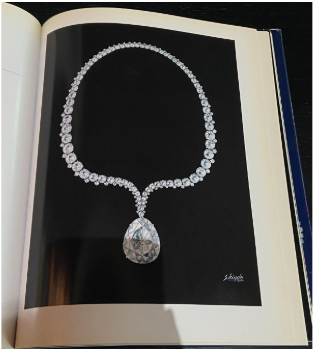
THE NEPAL DIAMOND NECKLACE,Designed by AV SHINDE, from the book, Harry Winston: The Ultimate Jeweller
For Shinde, the diamond was not a commodity but a living testament to time, pressure, transformation, endurance. In an age of synthetic replication, this belief feels almost radical. The world now praises the precision of lab-grown perfection, but Shinde found divinity in imperfection, the faint tint, the slight asymmetry, the individuality of a natural stone. To him, authenticity was not uniformity, but uniqueness.
Even as he rose to fame, Shinde remained profoundly modest. He lived simply, working quietly in his Manhattan studio, creating jewels for women who embodied different eras of beauty and power. His career spanned India’s independence, the fall of its princely states, and the rise of a new global luxury market, yet he never lost the humility of a man who once sketched on carbon scraps.
He retired in 2001 and passed away two years later, in 2003. But his philosophy endures, preserved in the archives of Harry Winston, in museum collections, and in the heirlooms that continue to dazzle red carpets and royal necklines. His jewels are less about possession than about presence: the way a diamond seems to breathe on the skin, the way light gathers and disperses like thought.
In the end, A.V. Shinde’s legacy is not merely aesthetic. It is ethical, almost spiritual, a reminder that mastery lies not in control, but in understanding. He taught the world that beauty is not born from abundance, but from restraint; that luxury, when rendered with sincerity, becomes art. And as the world now turns to engineered brilliance and technological exactitude, one can still imagine Shinde, pencil in hand, tracing the soul of a stone, letting nature speak through design.